From Speculation to Participation: Why the Smart Money Is Looking Beyond Traditional Crypto Trading
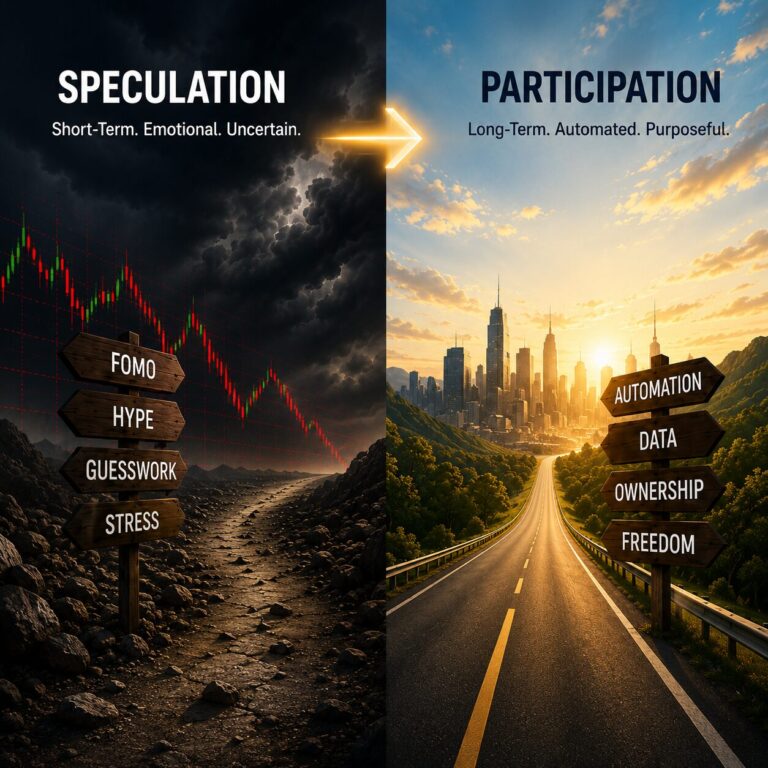
Crypto trading automation is changing how investors participate in digital markets, shifting the focus from emotional speculation toward disciplined, technology-driven decision-making.
For much of cryptocurrency’s history, success often depended on identifying the right coin at the right time. Today, however, crypto trading automation is helping many investors move beyond constantly watching charts and reacting emotionally to every market swing.
Why Crypto Trading Automation Is Becoming Essential
Crypto trading automation has become one of the most significant developments in digital investing. Rather than relying solely on human emotion or constant market monitoring, automated systems can execute predefined trading rules consistently, allowing investors to focus on strategy instead of split-second reactions.
Speculation remains part of every financial market, and crypto is no exception. However, the industry is no longer limited to buying and selling coins. Blockchain networks now support digital payments, decentralized financial services, tokenized assets, programmable ownership, automated systems, and entirely new forms of online economic activity.
As the technology matures, many experienced market participants are beginning to ask a different question. Instead of asking only, “What should I buy?”, they are also asking: “How can I participate in the infrastructure and activity creating value?”
The Limits of a Speculation-Only Mindset
Traditional crypto trading places enormous importance on timing. A trader must decide what to buy, when to enter, how long to hold, and when to exit. Even when the underlying analysis is sound, human behavior can interfere with execution.
Fear of missing out can lead to buying after a rapid price increase. Fear during a correction can trigger a sale at precisely the wrong moment. A winning trade can create overconfidence, while a losing trade can cause someone to abandon a strategy before it has been properly evaluated.
Markets also operate continuously. Crypto trades around the clock, across time zones, weekends, and holidays. No individual can monitor every price movement, news event, network update, and shift in market sentiment without interruption.
These realities do not make trading inherently flawed. They demonstrate why relying exclusively on short-term prediction can be difficult to sustain. A speculation-only approach often demands constant attention while exposing the participant to emotional, operational, and timing risk.
What Participation Means in the Digital Economy
Participation is a broader concept than ownership. It describes ways people and organizations can contribute capital, resources, technology, data, or liquidity to a digital ecosystem and potentially receive value in return.
Depending on the network and model, participation may include:
- Supporting blockchain security through staking or validation.
- Providing liquidity to decentralized markets.
- Using automated systems to execute predefined trading rules.
- Owning digital assets connected to access, utility, rewards, or governance.
- Participating in data-driven platforms and distributed digital services.
- Using tokenized representations of traditional financial or real-world assets.
These models differ significantly in structure and risk. Some depend on market activity. Others rely on network incentives, platform economics, fees, business revenue, or the usefulness of an underlying service. They should never be treated as interchangeable.
What connects them is the idea that digital assets can do more than sit in a wallet while their owner waits for a higher price. They can function as components within active economic systems.
Why Infrastructure Is Attracting Attention
Mature investors often look beyond a product to the infrastructure that supports it. During the expansion of the internet, value was created not only by websites but also by payment systems, software platforms, cloud infrastructure, data services, and communications networks.
A similar pattern is developing in digital assets. Bitcoin introduced blockchain-based scarcity, but the broader industry is now building settlement systems, stablecoin payment rails, tokenized securities, decentralized exchanges, custody systems, analytics platforms, and programmable financial products.
Major financial institutions are increasingly evaluating blockchain as infrastructure rather than treating crypto solely as a speculative asset class. Tokenization—the representation of financial or real-world assets on blockchain-based systems—is receiving particular attention because it may improve settlement, programmability, record keeping, and market access.
This does not mean every blockchain project will succeed. It means the underlying conversation has expanded. The market is gradually moving from “Is crypto real?” toward “Which parts of this technology are useful, scalable, and economically sustainable?”
Crypto Trading Automation Changes the Role of the Participant
Automation is one of the clearest examples of the transition from reactive speculation to structured participation.
An automated trading system does not know the future. It cannot remove market risk, guarantee a profit, or prevent every loss. Its value comes from a different source: the ability to monitor defined conditions and execute predefined instructions consistently.
A rules-based system can evaluate markets without becoming impatient, fearful, distracted, or overconfident. It can apply the same entry, position-management, and exit logic repeatedly, including when the operator is not watching a screen.
The important distinction is that automation replaces discretionary execution, not sound judgment. The quality of any automated system still depends on its strategy, risk controls, technical reliability, market assumptions, and ongoing evaluation.
Speculation-First Approach
- Focuses primarily on future price direction.
- Often depends on active monitoring and discretionary decisions.
- Can be heavily influenced by emotion and market narratives.
- Measures opportunity mainly through asset appreciation.
Participation-First Approach
- Examines how a network, platform, or system creates value.
- May use defined processes, automation, or infrastructure.
- Emphasizes utility, activity, incentives, and sustainability.
- Evaluates both potential rewards and operational risks.
Digital Ownership Is Becoming More Functional
The first wave of non-fungible tokens introduced many people to verifiable digital ownership. Public attention focused heavily on collectible images and rapidly changing prices, but the underlying technology is broader than either category.
A digital token can represent access, membership, identity, governance rights, participation in a platform, or a connection to a specific service. Its usefulness depends not on the label attached to it, but on the rights, systems, and economics behind it.
This is an important part of the speculation-to-participation transition. A digital asset should be evaluated not only by asking whether someone else may pay more for it later, but also by asking what role it performs now.
Does it provide access? Does it connect the owner to a functioning platform? Is there a transparent mechanism behind any benefit it claims to provide? Is the model dependent on new buyers, or is there an identifiable source of economic activity?
Those questions move the analysis away from hype and toward utility.
The Rise of Tokenized Real-World Assets
Tokenization provides another example of digital assets moving beyond conventional crypto trading. In a tokenized system, an asset or financial claim can be represented through blockchain-based records. Potential applications include funds, bonds, equities, private credit, real estate interests, commodities, and other assets.
The appeal is not simply that an asset becomes “crypto.” The potential value lies in what digital infrastructure may enable: faster settlement, programmable transactions, more efficient record keeping, fractional access, and greater interoperability between financial systems.
Tokenization also introduces legal, custody, verification, and investor-protection questions. A token is only as credible as the claim it represents and the framework enforcing that claim. Experienced participants therefore examine the complete structure—including custody, redemption, governance, and regulatory treatment—not merely the technology.
Participation Still Requires Due Diligence
Moving beyond traditional trading does not make an opportunity safe. In some cases, participation models introduce risks that are more complex than simply holding an asset.
Before becoming involved, a participant should understand:
- The source of value: Where do potential rewards or economic benefits originate?
- The role of the asset: Does it provide real utility, access, ownership, or participation?
- The technical risk: Could software defects, smart-contract failures, or operational errors cause losses?
- The custody model: Who controls the assets, keys, accounts, or underlying collateral?
- The liquidity risk: Can the position or asset be exited when needed?
- The regulatory environment: What laws or restrictions may apply?
- The transparency of the operator: Are the business model, risks, and limitations explained clearly?
Sustainable participation begins with understanding. High returns, complex terminology, or advanced technology should never replace basic questions about how a model functions.
What “Smart Money” Really Means
The phrase “smart money” is sometimes used to describe institutions, professional investors, or experienced market participants. It should not be interpreted to mean that these groups always make correct decisions. They do not.
In this context, smart money refers to a way of thinking: examining systems, incentives, risk, infrastructure, and durability instead of following price momentum alone.
A disciplined participant asks whether an opportunity can survive different market conditions. They look for repeatable processes rather than one-time outcomes. They evaluate downside exposure before focusing on potential upside. They distinguish a useful technology from a popular narrative.
Most importantly, they understand that participation is not passive simply because technology performs part of the work. Systems must still be selected carefully, monitored responsibly, and judged by transparent results.
From Market Watching to System Participation
Crypto’s first era was defined largely by ownership and speculation. Its next era may be defined by utility, infrastructure, automation, and participation.
This does not signal the end of trading. Price discovery and speculation will remain essential parts of digital-asset markets. The change is that trading is no longer the only way to engage with the technology.
Participants can now evaluate networks, services, automated systems, tokenized assets, and digital ownership models. They can ask not only whether an asset may increase in price, but also whether it performs a useful function within a sustainable ecosystem.
That broader perspective may be one of the most important signs that the digital-asset industry is maturing.
Where Karbon Collective Fits
As crypto trading automation continues to mature, more investors are recognizing that participation in digital markets doesn’t have to depend entirely on manually buying and selling assets. Technology can help remove emotion, improve consistency, and create a more structured approach to market participation.
The future of digital investing may not belong solely to those who make the boldest predictions. It may belong to those who combine sound research, disciplined risk management, and crypto trading automation to participate more consistently in the evolving blockchain economy.
As digital markets continue to evolve, the most important question may no longer be, “Which coin will rise next?”
It may be: “Which systems are creating real value, and how can I participate responsibly?”